
Lexington's new snow plan salts every ranked street within the first four hours of a storm and hands Man o' War and Alumni to a contractor. What changes and what to do.
Lexington has rewritten the way it fights snow and ice. The city calls its new plan “the biggest overhaul in 30 years.”
The biggest change comes before the first flake. Every ranked street is now salted within the first four hours of a storm, the city said in its Oct. 13 announcement. Contractors will take over several of the busiest roads, so city crews can get to neighborhood streets sooner.
The city said the 44-page plan would go before the public and an Urban County Council committee that day. The plan and an executive summary are on the city’s snow and ice control plan page.
“The last two years have been well outside historical norms,” said Charles Martin, the city’s interim commissioner of environmental quality and public works. “This plan must account for the need to adapt.”
What changes this winter
The city listed these major changes:
- All ranked streets salted within the first four hours of a storm
- More drivers on the response team
- A “Plan A/Plan B” bus schedule, still being worked out with Fayette County Public Schools, to cut the number of school closure days
- Rank 3 and Rank 4 streets merged into one category, so drivers can treat them more efficiently
- More staff for “hot spots,” contract work and public safety calls
- More staff inspecting routes, to put “eyes on the routes”
- Agreements with eight disaster response contractors, for quick extra help
- Man o’ War Boulevard, Alumni Drive, Polo Club Boulevard and Clays Mill Road treated by a contractor, leaving city crews free for lower-ranked roads
- A tighter incident command structure
- A new public winter weather dashboard with data on the city’s response
Martin said the team spent about seven months on the plan. “We are ready to test this plan and to look for ways we can continue to improve it,” he said.
Which streets get treated, and in what order
Not every street is plowed. The executive summary (PDF) says the city does not have the resources to fully treat every road. It has:
- 54 snow and ice treatment vehicles
- up to 56 drivers, working 12-hour rotating shifts
- 1,429 ranked lane miles to cover, out of about 3,657 lane miles in Fayette County
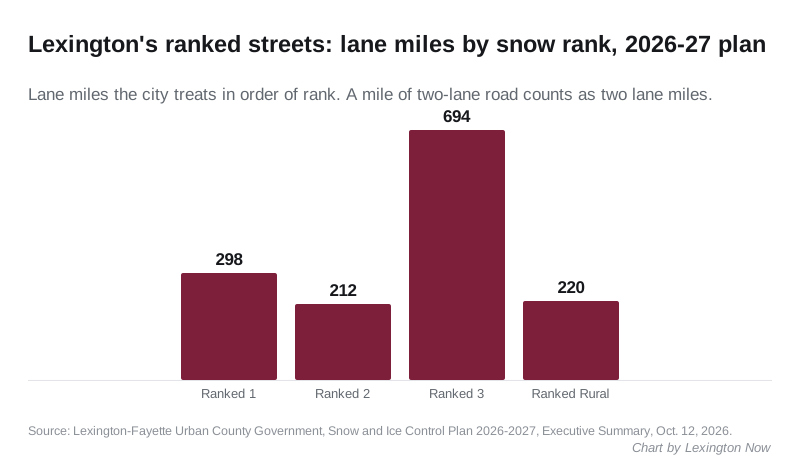
A lane mile counts each lane separately. A mile of two-lane road is two lane miles.
Streets are treated in rank order:
| Rank | What it covers | Lane miles |
|---|---|---|
| Ranked 1 | Main arteries between downtown and New Circle Road, such as Main Street, Nicholasville Road and Richmond Road, plus routes to fire stations, hospitals and police | 298 |
| Ranked 2 | Major connecting streets such as Red Mile Road, Lane Allen Road and Loudon Avenue, and streets to big offices, groceries and gas stations | 212 |
| Ranked 3 | Main routes through neighborhoods, and streets needed to open schools | 694 |
| Ranked Rural | Ranked roads in the rural county | 220 |
The goal for low-traffic streets is “passable.” The plan defines that as at least one travel lane clear enough to drive at reduced speed, even if snowpack remains.
The state’s roads are not the city’s
Several of the county’s busiest roads belong to the Kentucky Transportation Cabinet, not the city. The plan names Interstate 75, Interstate 64 and New Circle Road. It also lists state and federal highways outside New Circle Road, such as Nicholasville Road, Richmond Road and North Broadway. Complaints about those roads go to the state.
Snow emergencies and parking
The mayor or the chief administrative officer can declare a snow emergency. The plan sets out four levels:
- Level 1.a: the governor declares a state emergency, and the city weighs the risk to Fayette County
- Level 1.b: no parking on designated snow emergency routes
- Level 2: no parking on snow emergency routes, plus alternate-side parking on residential roads: even-numbered side on even days, odd side on odd days
- Level 3: no travel on snow emergency routes without snow tires, chains or four-wheel drive, except emergency vehicles and vehicles the mayor approves
The snow emergency routes are a 76-mile network, the plan says.
A new emergency management director by winter
The city’s emergency management chief is leaving before the snow arrives. Robert Larkin, director of the Division of Emergency Management since 2024, plans to retire Jan. 1, the city announced Monday. January marks 35 years of public safety service for Larkin, a former assistant chief in the Division of Fire and Emergency Services. Read more in our story on Larkin’s retirement.
Mayor Linda Gorton said she plans to name a new director in early December. “I want to have a new person in place and ready to go when our winter weather is normally at its most challenging,” she said.
What it means for you
The plan asks residents to help in these ways:
- Stay off the roads except in emergencies. If you must drive, allow extra time and leave room between cars.
- Get cars off the street. Parked cars slow plows and block first responders.
- Clear your sidewalk, so students walking to bus stops stay out of the road.
- Keep snow forts and snowmen out of the street. Children behind them are hard for drivers to see.
- Clear about 10 feet along the curb to the left of your driveway, as seen from your front door. The plow can drop snow there instead of at the end of your driveway.
- Report problems to LexCall at 311 or (859) 425-2255, 8 a.m. to 6 p.m. weekdays. LexCall opens around the clock when the full snow team is called out. The city asks people to report through LexCall, not social media.
During a storm, the city posts updates on its snow and ice updates page. Keep our power outages page and getting around guide handy, and check road construction and closures before you drive.
Have your say